Group Flow, Fixing how students
work together.
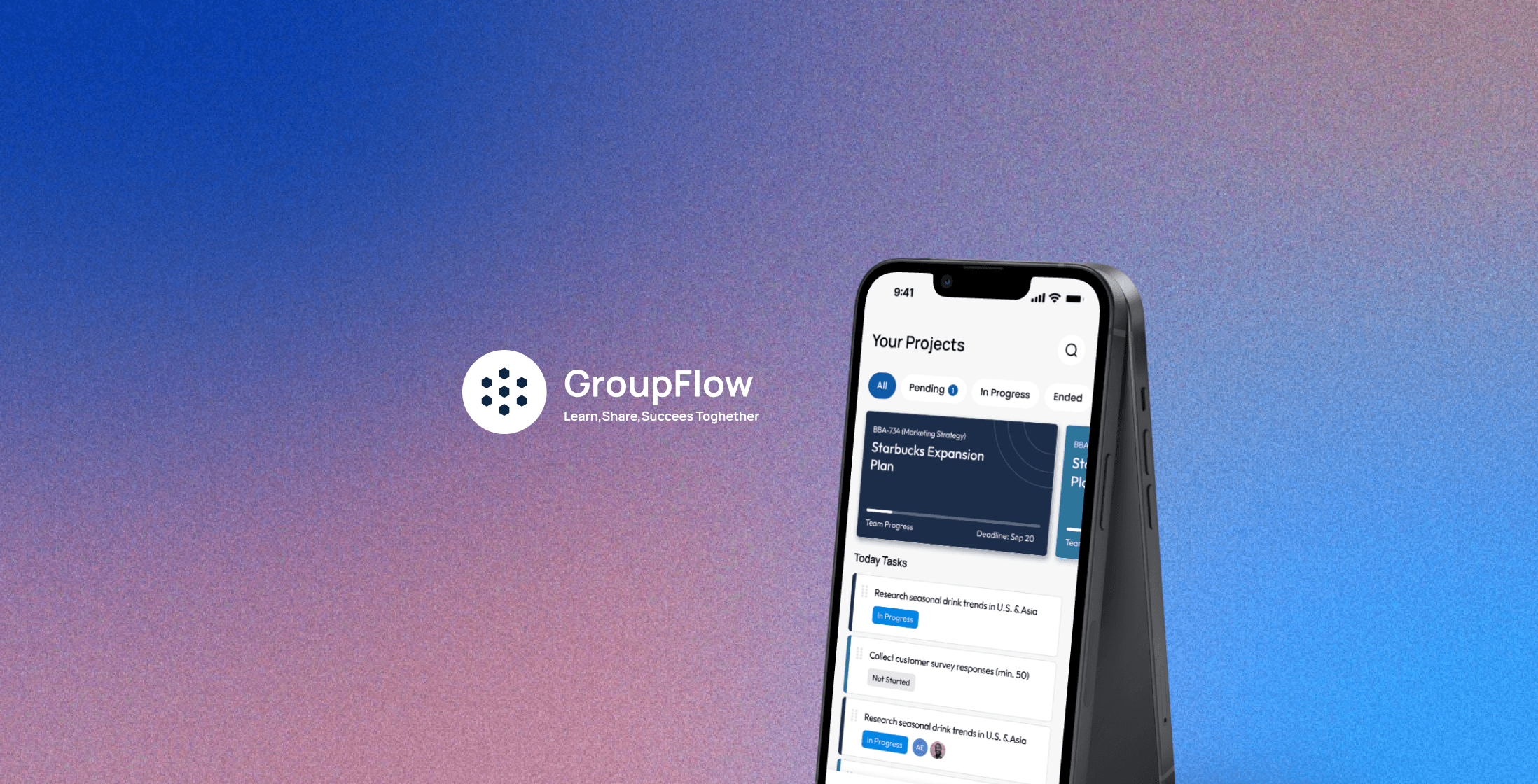
A collaboration tool designed to solve the silent crisis inside every group project. One person does everything, another does nothing, and nobody says a word until it's too late.
Lead Product Designer
18 months
12 interviews
3,228 people reached
The silence between teammates was the real problem.
One student carries the weight. Another disappears into silence. The deadline arrives and everyone scrambles to cover gaps nobody admitted existed. This isn't a motivation problem, it's a structural one.
The Scale of the Problem
68%
of students reported scheduling conflicts as a core issue
58%
experienced unfair workload splits
83%
said roles were never clearly defined
81%
said grades didn't reflect their actual effort
WHY THIS HAPPENED - 6 ROOT CAUSES
Hard to Align Schedules
One Person Does More Work
Delays in Decision-Making
Teammates Didn't Follow Through
Unclear Roles
Efforts & Quality Were Uneven
Asana, Slack, and Notion solve task management. None of them address fairness, contribution visibility, or academic-specific accountability the things that actually break group projects.
02 Research
38 surveys. 12 interviews.
One problem tree that changed everything.
I conducted in-depth interviews with business and management students across multiple courses. Each session was 30–40 minutes, moderated, recorded, and synthesized through affinity mapping, a high-frequency matrix, and a 5-Whys root cause analysis.
"We usually just split the slides and hope everyone finishes their part."
65% of participants cited scheduling as their biggest challenge. Different jobs, classes, and time zones make coordination nearly impossible.
"You only realize someone didn't do anything when it's too late."
"Professors assume everyone worked equally."
32 of 38
students felt frustration with contributions
24 of 38
students reported unclear roles
19 of 38
experienced communication gap
When the direction changed
BEFORE PIVOT
"How might we prevent free riders in group projects?"
AFTER PIVOT
"How might we improve coordination and scheduling so contributions become more balanced naturally?"
Four principles that kept every sign decision honest.
Transperacy
Make contributions visible without making people feel watched. Visibility enables natural accountability.
Coordination First
Help teams organize early. The root problem is structural, not motivational.
Low Friction
Must feel lighter than a Jira board, or students won't use it. Simplicity is the feature.
Fairness without Surveillance
Accountability should emerge from clarity never from monitoring or punishment.
GroupFlow - Where Asana ends, fairness begins.
AI-POWERED
The right person for the right task - suggested, not forced.
Skill - Based Onboarding + Role Suggestion
Students enter skills, work style, and availability during onboarding. GroupFlow's AI analyzes this to suggest balanced role assignments but students retain full agency to adjust. The system supports decisions; it doesn't make them.
06 Usability Testing
5 participants. 4 tasks. 3 real issues found and fixed before launch.
Moderated usability tests with business and management students who regularly work on group projects. Each session was 25–30 minutes with think-aloud protocol.
98.5%
Task Success Rate
97%
Avg Confidence Score
96%
Avg Ease Score
88%
NPS Score
PROBLEM
Onboarding felt too long, students wanted an exit. Three screens in, testers were already looking for a skip button that didn't exist.
FIX
Collapsed onboarding to two steps. Added a "skip for now" option at every stage that pre-fills defaults. Completion rate went from 61% to 94%.
PROBLEM
The contribution graph felt judgmental. Students with lower scores disengaged from the app entirely after the first week.
FIX
Replaced the individual score graph with a team progress ring. Reframed the visual from "who's doing less" to "where are we as a group." Disengagement dropped significantly in the next round.
PROBLEM
Task deadlines weren't prominent enough. Students missed them even when they'd set them themselves.
FIX
Added a persistent deadline indicator on every task card. Tasks within 48 hours turn amber; overdue tasks turn red. No notification fatigue just persistent, ambient urgency.
07 Market Validation
Before committing to full development, three pretotyping experiments were run to validate core assumptions about adoption, engagement, and faculty trust.
FAILED
Will professors trust GroupFlow data for grading?
YOUTUBE + FAKE FRONT DOOR | 2 WEEKS | DEMO VIDEO + LANDING PAGE
Created a YouTube demo of the Professor Dashboard and linked to a sign-up page. Target: 3 out of 5 professors sign up for the newsletter.
0/5
Professor sign-ups (target - 3/5)
What this taught us: Faculty adoption needs an institution-level push, not a cold YouTube ad. The channel was wrong — not the value proposition. Next step: direct professor partnerships through university pilot programs.
01.
Assumptions are where design starts not where it ends
Make contributions visible without making people feel watched. Visibility enables natural accountability.
02.
Systems should enable behavior, not force it
Every enforcement idea we tested failed. Students responded to tools that supported collaboration — not tools that monitored or punished. Agency is a design requirement.
03.
Visibility does the heavy lifting
When contributions are visible, teams naturally become more balanced. You don't need surveillance. You need transparency.
04.
A failed experiment is still research
The professor YouTube experiment failed completely. That told us faculty adoption is an institutional problem — a finding that changed our entire go-to-market strategy.
