Lead Designer
6 months
E-Commerce Integration
+18% Checkout Conversion

THE CHALLENGE
A trusted brand with zero online sales.
Bona had 100+ years of floor care expertise but their website couldn't sell a single product. I designed the complete eCommerce experience from scratch IA, discovery paths, quiz, filters, and checkout.
US household-care eCommerce market in 2024 Bona's website wasn't capturing its share.
Of cleaning products still purchased offline a major conversion opportunity.
CONSTRAINTS
CONSTRAINT 01
Fragmented IA
Product data was scattered with no shared taxonomy impossible to build smart filters or discovery flows without rebuilding the information architecture from zero.
CONSTRAINT 02
Cross-Platform Compatibility
eBay, Etsy, and Shopify each had different product specs, image requirements, and listing formats. One design system had to work consistently across all three.
PROCESS
01. STRATEGY
Align goals
Baymard audit + stakeholder interviews. Identified discovery and checkout confidence as the two highest-impact problems.
02. SCOPE
Define MVP
MoSCoW prioritization. Shopping cart, smart filters, product quiz, user segmentation. Multi-currency scoped out to stay focused.
03. STRUCTURRE
Rebuild IA
Two distinct paths homeowner by surface type, professional by spec sheet. 6+ steps compressed to 3 clicks.
04. SKELETON
Wireframe
Lo-fi → mid-fi across homepage, PLP, PDP, quiz, and checkout. 3 rounds before touching a single color.
05. SURFACE
Build it
Full hi-fi UI in Bona's palette. Component library. Responsive across all devices. Dev-ready annotated specs.
SOLUTION
CORE FEATURE
Product finder quiz
A short 4-question quiz that routes users directly to the right product — eliminating the browsing paralysis that was the #1 drop-off point on the existing site.
View Prototype
Problem it solved
Browsing paralysis from 100+ products with no clear path
HOW IT WORKS
1.
Floor type
Hardwood, Laminate, Stone, or Tile
2.
Room size
Area and usage frequency
3.
Finish and concerns
Stain, scent, eco preference
4.
Your 3 products
Personalized with frequency + quality
FEATURE 01
Smart Filter System
Two-layer architecture built around who the user is not how Bona categorizes products internally.
View Prototype
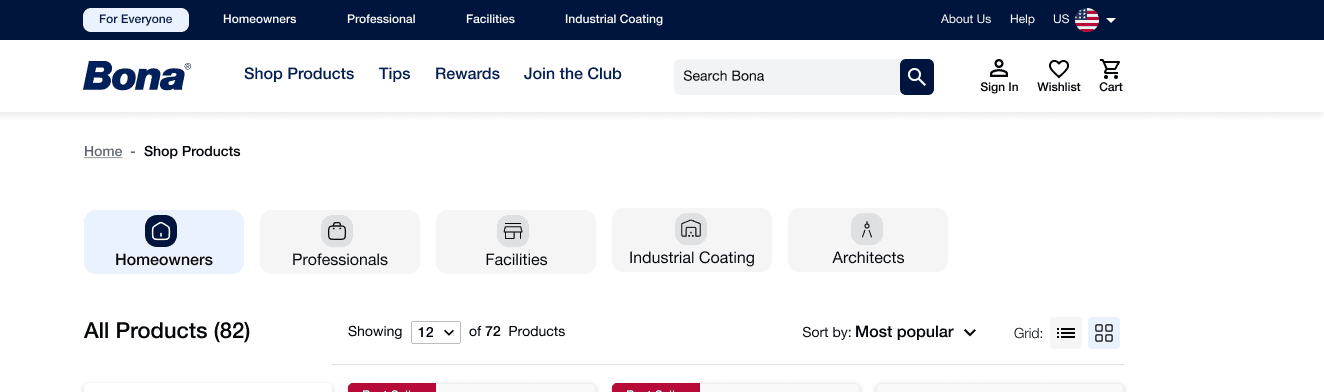
01. TOP NAV
Who are you shopping for?
First decision before anything else. Instantly scopes 82 products to the right subset. Homeowners see cleaners. Professionals see coatings and adhesives.
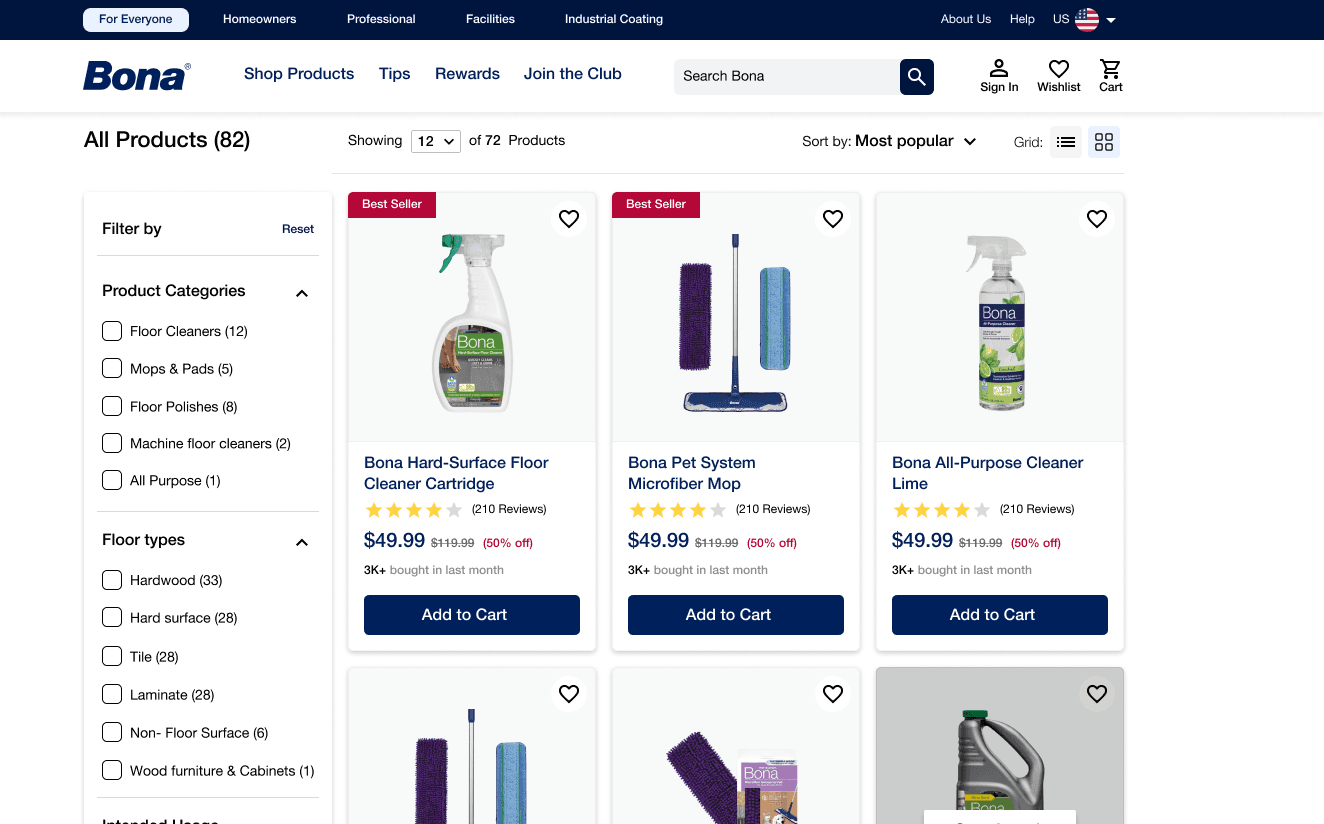
02. SIDEBAR PANEL
Who are you shopping for?
Labels use plain language not internal SKUs. Progressive disclosure keeps the UI clean. Only expand what you need.
FEATURE 02
Checkout in 3 steps.
Cut from 6 steps to 3. Persistent cart, inline validation, trust signals at every stage.
View Prototype
BAYMARD SCORE FOR THE WEBSITE IS 85.7

1.
Cart
Order summary always visible. Edit inline without losing your place in the flow.
2.
Shipping
Inline validation on every field. Address autocomplete. No format surprises.
3.
Confirm
Full order summary before payment. Trust signals throughout. Nothing hidden at the end.
RESULTS
Checkout conversion rate
To the right product
Unified design system
LEARNINGS
01
IA is invisible until it's broken
The +18% lift came from restructuring information architecture — not visual design. Users couldn't buy what they couldn't find.
02
Benchmarks beat opinions
Using Baymard Institute data to identify the worst checkout patterns gave every design decision a research foundation.
03
Personalization at the entry point
Ask "who are you?" before "what do you want?" — it dramatically reduces cognitive load at the most critical moment.
